


CASE STUDIES
Published on Dec. 18th 2025
How OptimScan Scanners Excel at Capturing Complete Data in Deep or Recessed Features with Monocular-Stereo Fusion Function
The monocular-stereo fusion function can effectively increase data coverage and improve the integrity of the scanned data, such as the common turning corners and joints of industrial parts.
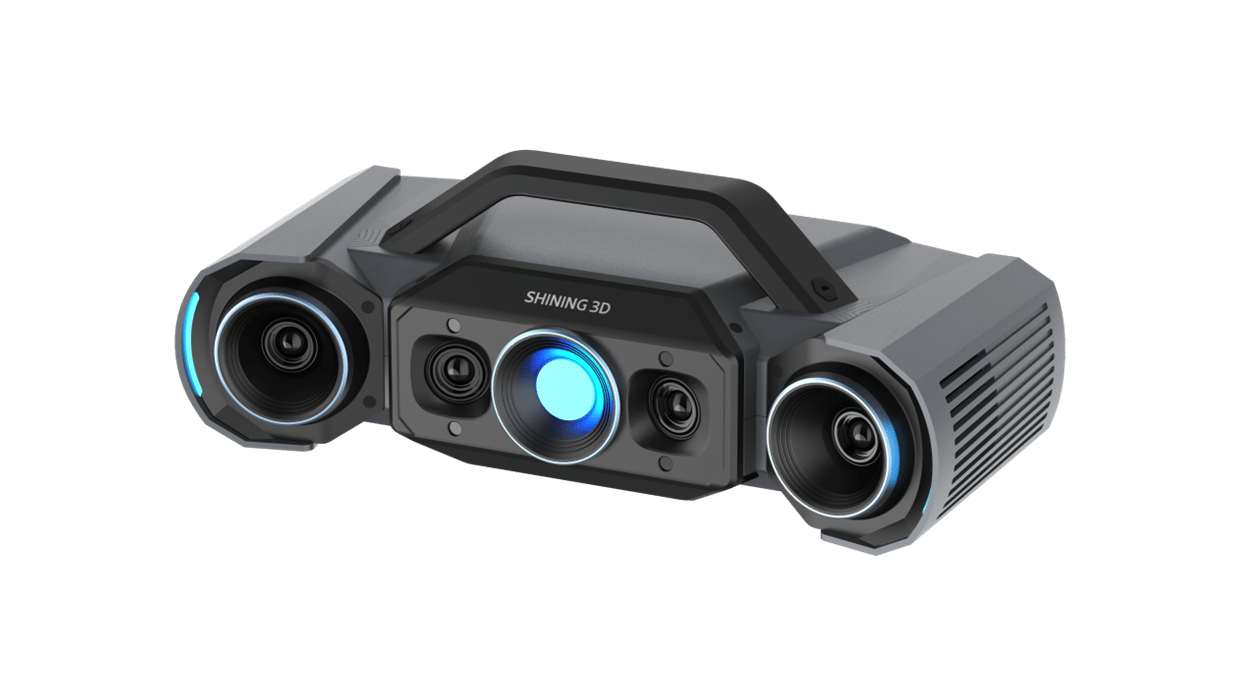
As 3D scanning technology continues to advance, fixed fringe projection scanners are not only maintaining their high accuracy and exceptional detail reproduction, but also becoming increasingly portable and efficient. SHINING 3D’s OptimScan scanners combine extreme accuracy with four industrial cameras and introduces dual built-in scan ranges that switch instantly in software without manual lens changes or refocusing. The system also incorporates a Monocular-Stereo Fusion (MSF) function, specifically engineered to maximize data completeness.
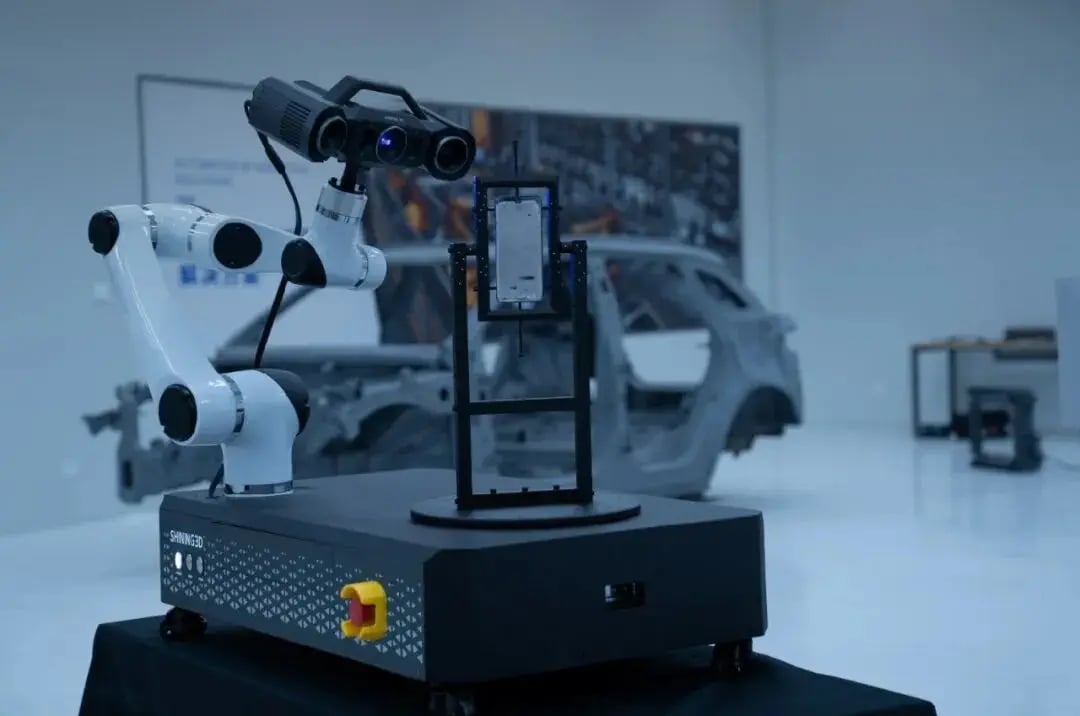 OptimScan scanners support integration with the RobotScan automated 3D inspection system, enabling fully automated, batch-based full-field inspection.
How Monocular-Stereo Fusion Enables Efficient, Full-Coverage Scanning of Complex Areas
For small and medium-sized precision parts, dimensional measurement of grooves, recesses, and narrow gaps has long been a challenge. Traditional fixed 3D scanners often cannot capture these areas in a single pass due to lens angle limitations. Operators must repeatedly adjust angles and rescan, resulting in lengthy workflows. The MSF function solves this issue at its root. But how does the technology actually work?
When MSF is enabled, the scanner captures three fully independent data sets simultaneously when scanning recessed features: stereo data captured by both left and right cameras, monocular data from the left camera, monocular data from the right camera.
These three data sets are then automatically fused by the system’s onboard intelligent algorithms. The combined output fills in areas that are inaccessible to a single viewpoint, producing highly complete scan results for grooves, cavities, and other constrained geometries.
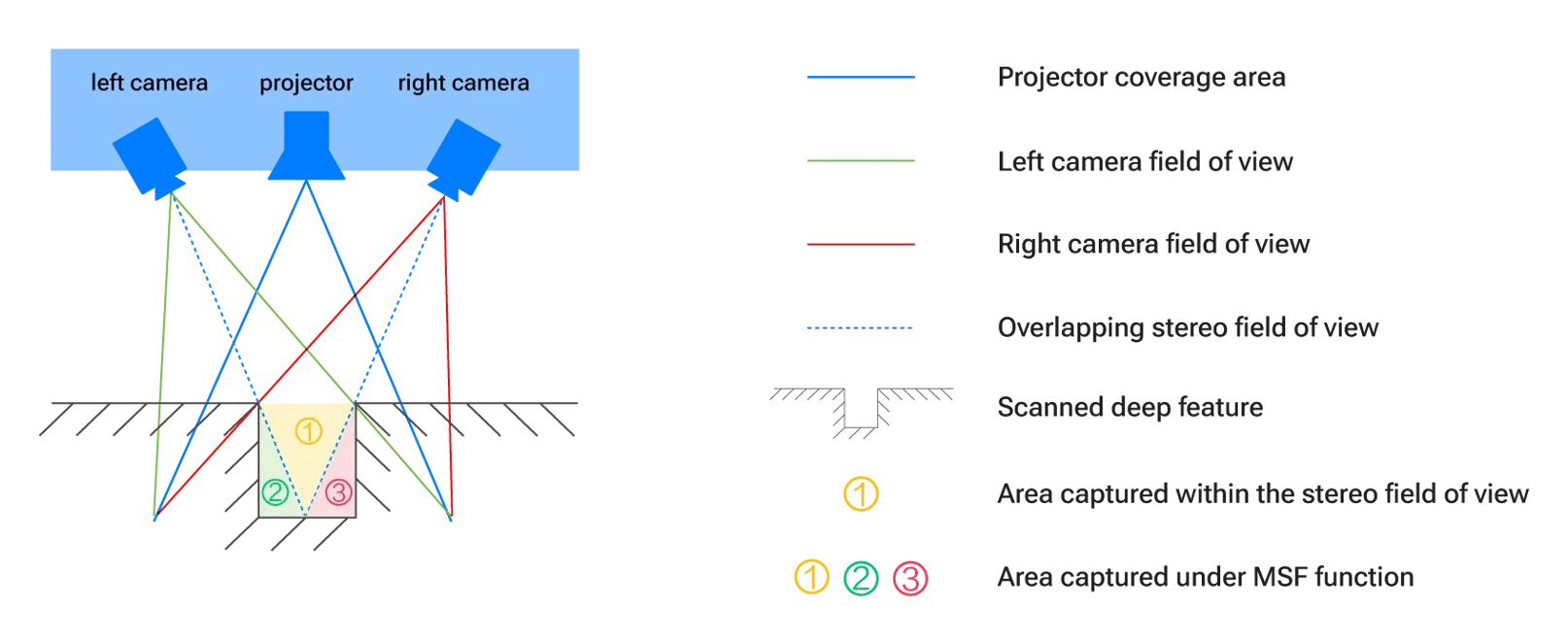
Principles of MSF
Efficiency Gains and Quality Improvements Delivered by Monocular-Stereo Fusion
The MSF function delivers measurable gains in both efficiency and data quality, meeting the stringent demands of industrial metrology.
Efficiency Improvements
For parts with sharp transitions, intersections, recesses, or other complex structures, users can now obtain complete data in a single scan, eliminating repeated repositioning and multiple capture cycles. This significantly shortens scanning time and reduces dependence on operator skill, enabling a more streamlined workflow.
Data Quality Enhancements
MSF function effectively eliminates traditional blind spots. Deep grooves, narrow seams, and internal surfaces that were previously difficult or impossible to fully capture due to lens angle constraints are now covered comprehensively. The resulting datasets are more complete and provide a stronger foundation for industrial applications.
Share on Social Media


