



CASE STUDIES
Published on Apr. 14th 2026
Transforming Aircraft MRO Dent Inspection with SHINING 3D Metrology’s FreeScan Omni
Manual dent inspection slows down aircraft MRO. Learn how SHINING 3D Metrology’s FreeScan Omni enables faster, more reliable aircraft MRO dent inspection digital inspection.
The Criticality of Aircraft Skin Integrity and Dent Monitoring
In the demanding environment of civil aviation Maintenance, Repair, and Overhaul (MRO), the structural integrity of an aircraft’s skin is non-negotiable. Despite robust structural design, the fuselage and wings are susceptible to dents caused by a variety of operational factors. The most common sources of dents include:
-
Foreign object debris (FOD): Stones, runway debris, or hard pavement fragments kicked up during taxiing, takeoff, or landing.
-
Severe weather events: Hailstorms can leave hundreds of impact marks on leading edges and upper surfaces.
-
Bird strikes: High-velocity impacts—particularly on wing leading edges, radomes, and fuselage sections—create localized deformation that must be rigorously assessed.
-
Ground handling incidents: Impacts from service vehicles, cargo loaders, or even jet bridges.
While these incidents may appear as minor surface “dents”, they can compromise aerodynamic efficiency and, more critically, lead to structural fatigue or hidden stress concentrations.
According to the Structural Repair Manual (SRM), every deformation must be accurately measured and documented to determine if it falls within Allowable Damage Limits (ADL). Failure to detect a critical dent or miscalculating its depth can jeopardize airworthiness and lead to catastrophic structural failure.
The Bottleneck: Traditional Measurement Workflow
For a single, isolated dent, a skilled technician typically requires approximately 2 minutes to perform a complete assessment—locating the deepest point, measuring depth relative to the undamaged contour using a depth gauge or graduated bridge, and manually recording the result.
However, real-world scenarios are rarely this straightforward. After events such as hailstorms or bird strikes, aircraft surfaces—like wings or horizontal stabilizers—can contain dozens or even over a hundred dents distributed across a large area. In these cases, measurement time quickly escalates:
100 dents x 2 minutes = 200 minutes (over 3 hours) of active measurement time
This estimate does not include time spent navigating around the airframe, manually entering data, or transferring measurements to engineering teams for SRM evaluation.
Beyond the time burden, the traditional manual approach introduces two critical risks:
-
Human Variance: The repeatability of depth gauge placement depends heavily on the technician experience and fatigue.
-
Data Fragmentation: Manual records (handwritten numbers or photos) are difficult to visualize, archive, or share with engineering teams for SRM disposition.
In the context of Aircraft on Ground (AOG), where downtime directly translates into significant financial loss, inspection speed becomes critical. At the same time, safety standards leave no room for compromise.
MRO providers are therefore under increasing pressure to reduce turnaround time (TAT) while improving measurement accuracy and traceability. Under these constraints, transitioning from manual tools to digital, metrology-grade inspection is no longer optional—it is a necessary step toward more efficient and reliable operations.
Discover the product you're looking for
- Full specifications
- Using scenarios
- Key features
- Even comes with a bundle!
The Digital Leap: FreeScan Omni for Streamlined Automated Dent Analysis
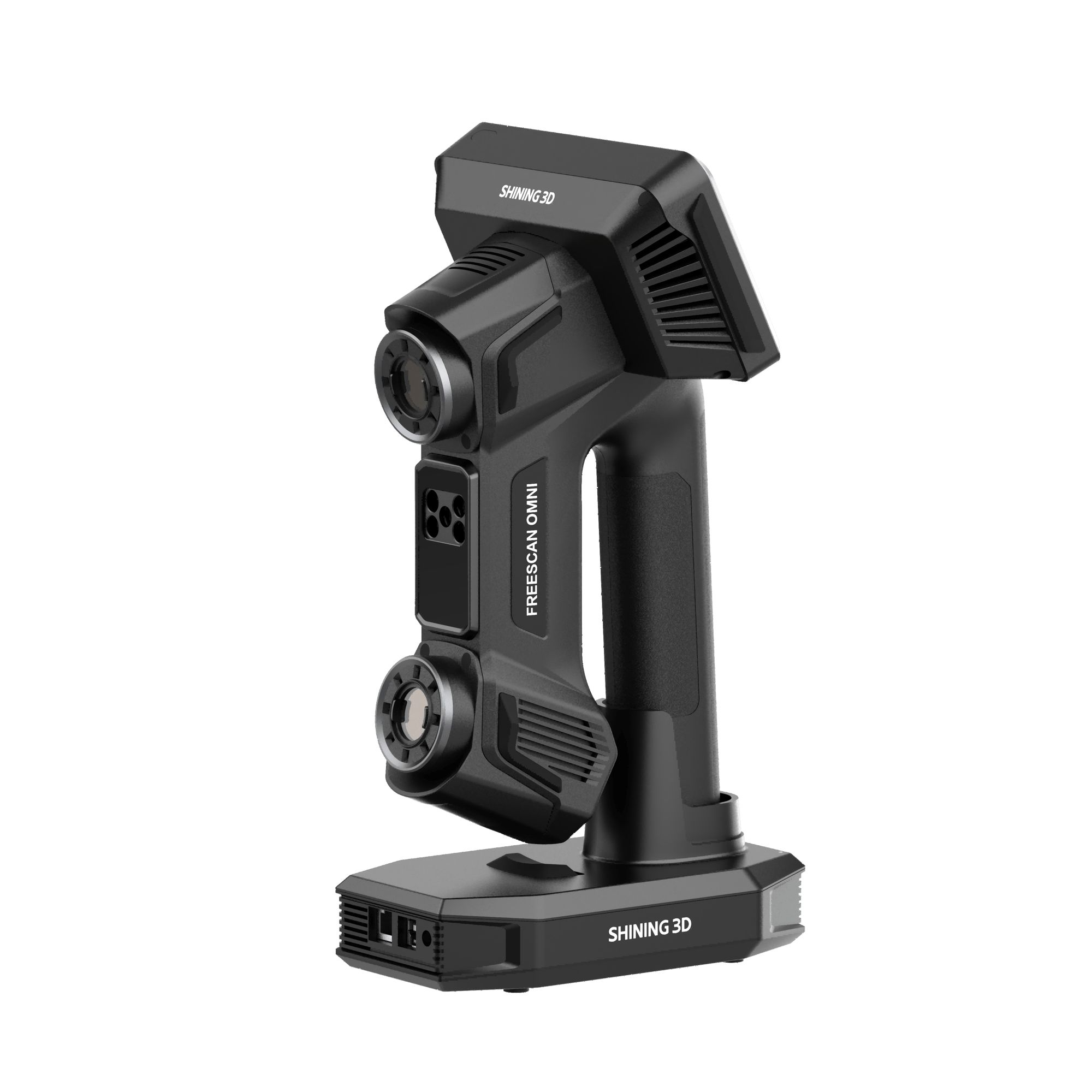
To address these challenges, SHINING 3D Metrology introduces FreeScan Omni, a standalone inspection-ready metrology 3D scanner, highly suitable for the high-stakes environment of MRO. Equipped with onboard computing and an integrated PTB-certified inspection module, FreeScan Omni enables a full on-site workflow: scanning, automated dent detection and measurement, and visualized 3D reporting—all from a single device.
FreeScan Omni delivers metrology accuracy of 0.02 mm and uses advanced laser scanning technology optimized for reflective and low-feature surfaces such as aluminum and composites.
How It Works:
1. Scan: The technician walks around the affected area and captures the surface geometry with wireless & standalone FreeScan Omni.
2. Detect: The system automatically identifies dents and surface deviations from the scanned data.
3. Measure: Key dimensions, such as dent depth and position, are calculated automatically.
4. Report: A clear, visual 3D report is generated for engineering evaluation.
Key Advantages in the Civil Aviation MRO Context:
Operational Agility (Wireless & Integrated)
FreeScan Omni eliminates setup complexity. In the hangar or on the apron, inspections can begin immediately—no external laptop, no cables, no waiting. This flexibility allows technicians to work directly at the aircraft, even in constrained environments.
Speed at Scale
Unlike manual tools that require 2 minutes per dent, FreeScan Omni captures the entire affected area in a single scan. Whether there are 10 or 100 dents, inspection time remains measured in minutes, significantly reducing overall turnaround time (TAT).
Traceable, Standardized Reporting
All inspection results are automatically compiled into structured, visual 3D reports. Compared to handwritten notes or scattered photos, these digital records are easy to review, archive, and share—ensuring full traceability and supporting consistent SRM evaluation.
Cost-Effective & Efficient Operations
By shortening aircraft ground time (AOG), reducing rework caused by measurement inconsistencies, and providing auditable data for engineering decisions, FreeScan Omni delivers measurable cost savings and long-term operational efficiency.
Beyond Dent Inspection: A Broader Vision for Civil Aviation
While dent inspection is a critical use case, it represents just one part of a much larger opportunity for digital transformation in civil aviation MRO.
From airframe inspection and component verification to reverse engineering and digital documentation, SHINING 3D Metrology provides a comprehensive portfolio of 3D scanning solutions tailored to the evolving needs of the aviation industry. By enabling faster data capture, more consistent measurement, and fully digital workflows, these solutions help MRO providers improve efficiency while maintaining strict safety and compliance standards.
Explore how SHINING 3D Metrology supports civil aviation applications across the entire lifecycle.
Related Civil Aviation Case Studies
1. High-Precision 3D Scanning of Electric Aircraft – FH Aachen used FreeScan Trak Nova for full-aircraft digitization with high flexibility and accuracy. Read more
2. Faster PMA Component Inspection – A Thai manufacturer cut aircraft PMA inspection time to half a day using SHINING 3D metrology scanners. Read more
3. Rapid Reverse Engineering for Engine MRO – FreeScan UE enabled fast, accurate reverse engineering of complex engine components. Read more
FreeScan Omni
FreeScan Omni redefines handheld 3D metrology with its on-scanner inspection capability and wireless, standalone design. From production floor checks to metrology lab measurements and fieldwork on the go, FreeScan Omni delivers consistent performance wherever it's needed.
- On-Scanner Scan-To-Inspect
- Standalone & Wireless Design
- PTB-Certified Inspection Module
- Multi-Mode & High-Performance
Share on Social Media


