


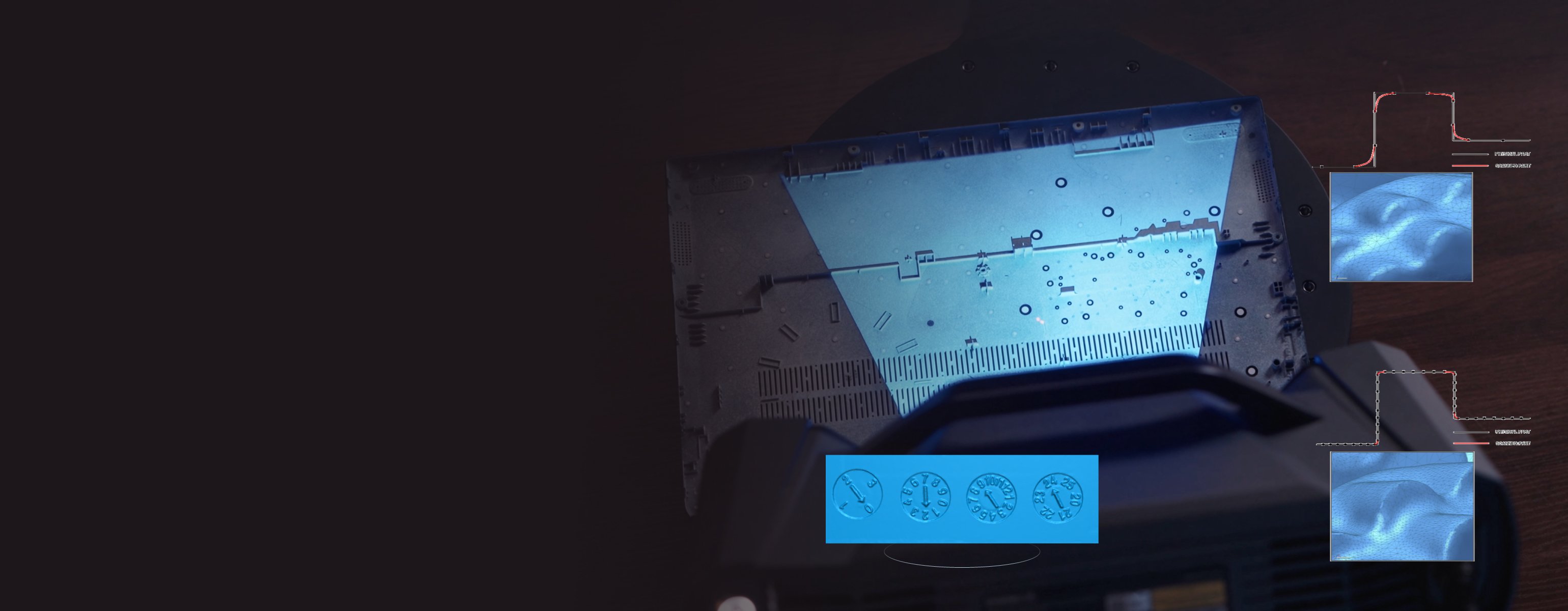
Guides/101
Published on 17th Nov 2026
What Factors Affect Your 3D Scanning Details?
This guide examines how camera resolution, field of view (FOV), point distance,optical performance, and data processing algorithms influence a scanner's ability to capture fine geometric details.
When evaluating a 3D scanner, camera resolution is often one of the first specifications people notice. A higher megapixel count indicates a greater number of image pixels, providing more information for data acquisition. However, camera resolution alone does not determine the level of detail captured in a 3D scan.
The field of view (FOV), point distance, optical performance, and data processing algorithms all contribute to the final level of detail. This guide examines how these parameters interact and how they influence a scanner's ability to capture fine geometric details.
For a visual introduction to these concepts, watch this episode of Metrology TechTalk.
Camera resolution refers to the number of pixels a camera uses to capture an image. Generally, a higher-resolution camera provides more pixels, allowing more image information to be recorded.
However, the total number of pixels is only part of the equation.
Consider a simple example: if you want to see a small object clearly, you have two options:
- Increase the number of pixels available to capture it.
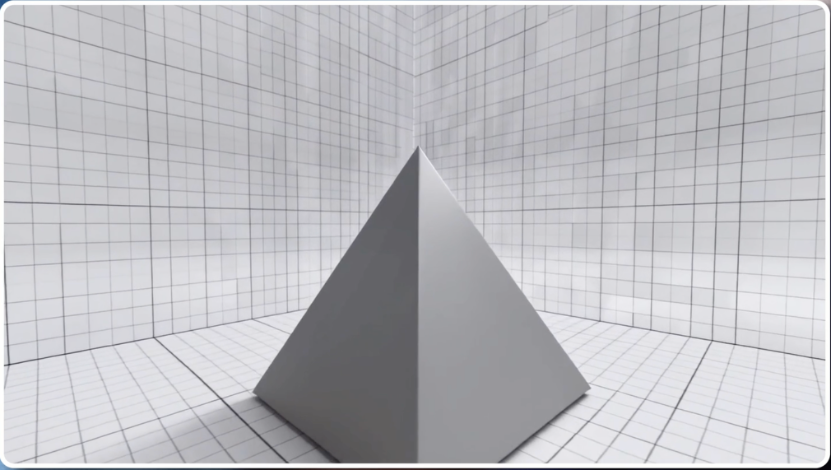
- Make the object occupy a larger portion of the image.
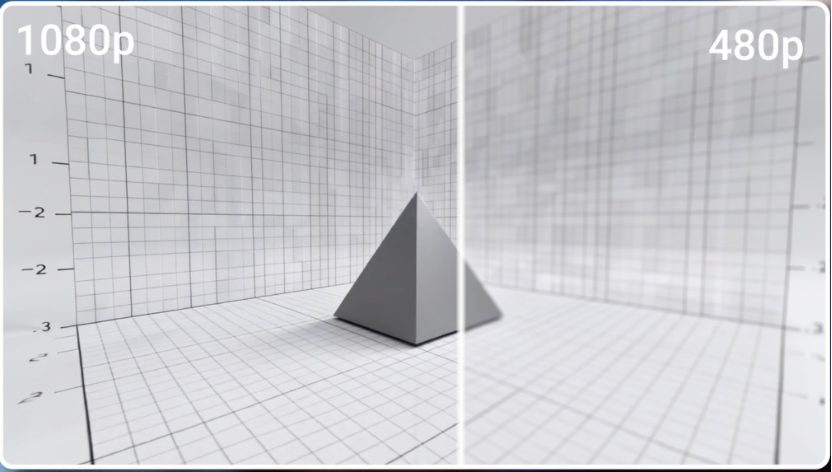
The pixel with 1080p is clearly than 480p
The object is occupy a larger portion of the image
3D scanning follows a similar principle. A higher-resolution camera provides more pixels, but what matters just as much is how much of the scanned object those pixels are covering.
This brings us to another important parameter: Field of View (FOV).
Field of View (FOV): How Much Area Are the Pixels Covering?
In 3D scanning, the field of view (FOV) defines the area that a scanner can capture at a given working distance. In simple terms, it determines how much of an object's surface is captured in a single scan frame.
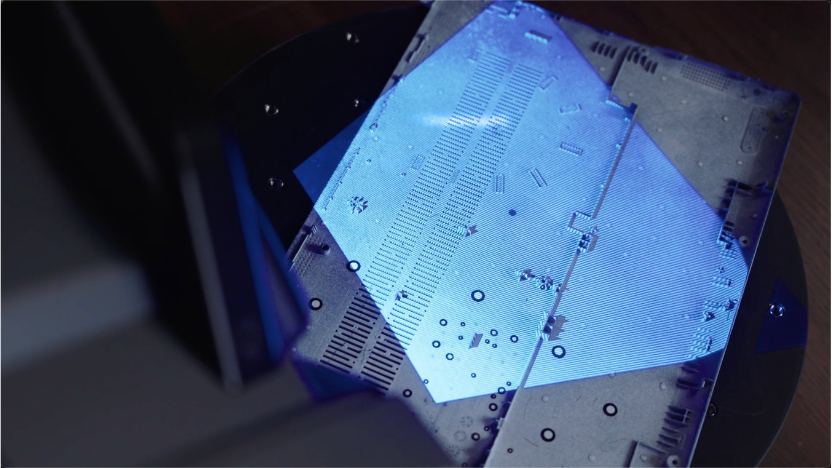
The area that OptimScan Q12 can capture
For a camera with a fixed resolution, reducing the FOV generally increases the spatial sampling density, assuming comparable camera and imaging conditions.
This means that the same camera resolution can produce different spatial sampling densities depending on the scanning range.
Point Distance: A Key Parameter for Understanding 3D Detail
One important parameter directly related to spatial sampling is point distance. It refers to the spacing between neighboring points in a 3D point cloud. It indicates how densely the object's surface is represented by the captured 3D data.
3D Point Cloud
Generally:
- Smaller point distance: Denser point distribution and a greater potential to capture fine geometric features.
- Larger point distance: Sparser point distribution, which may make smaller surface features harder to represent.
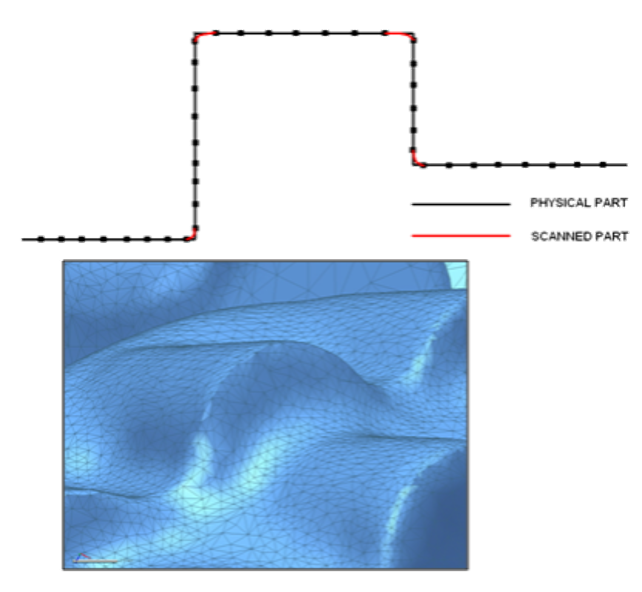
Smaller point distance with denser point distribution
Larger point distance wiht sparser point distribution
Under comparable scanning conditions, a smaller point distance generally provides a better basis for capturing fine geometric details.
However, point distance should not be confused with accuracy or resolution in the broader sense. It describes the spacing of sampled points, not necessarily how accurately each point represents the object's true position.
To understand this relationship more clearly, let's look at a real example.
The OptimScan Q12 features two pairs of 12.3-megapixel cameras designed for different scanning ranges. Although both camera pairs have the same resolution, their fields of view are different.
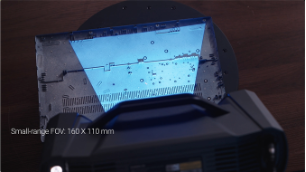
Small range FOV
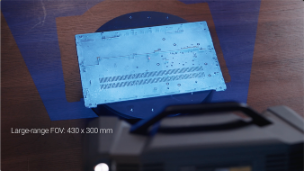
Large range FOV
For a simplified theoretical estimation, the horizontal spatial sampling interval can be calculated by dividing the horizontal FOV by the number of horizontal pixels. A 12.3-megapixel camera has approximately 4,000 pixels across its horizontal direction.
-
Small-range mode: 160 mm ÷ 4,000 pixels = 0.04 mm/pixel
-
Large-range mode: 430 mm ÷ 4,000 pixels ≈ 0.11 mm/pixel
Note: The values above are simplified theoretical estimates based on horizontal FOV and approximate horizontal pixel count. They represent the spatial sampling interval at the image level and should not be interpreted as the scanner's specified point distance or measurement accuracy.
|
Specification |
Small Range | Large Range |
|---|---|---|
|
Camera resolution |
12.3 MP | 12.3 MP |
|
Horizontal FOV |
160 mm | 430 mm |
|
Vertical FOV |
110 mm | 300 mm |
| Approx. horizontal pixel count | 4,000 | 4,000 |
| Approx. spatial sampling | 0.04 mm/pixel | 0.11 mm/pixel |
The difference is clear. Even though both camera pairs have the same resolution, the small-range mode distributes the available pixels across a much smaller area. This results in denser spatial sampling and a smaller theoretical sampling interval.
The difference becomes more apparent when comparing real scan data.
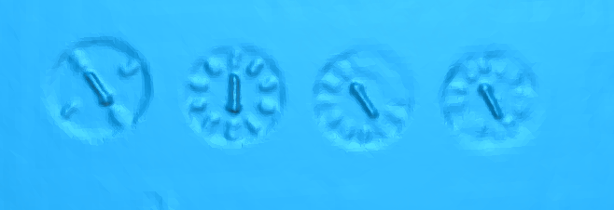
Scanned Data under OptimScan Q12 Large Range
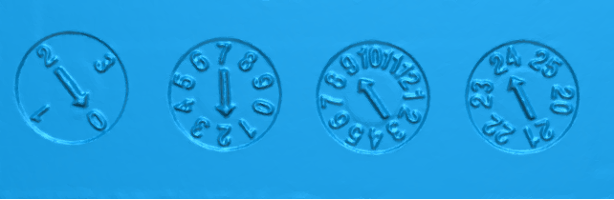
Scanned Data under OptimScan Q12 Small Range
In the large-range mode, certain fine features may not be sufficiently represented. When switching to the small-range mode, these details can be captured more clearly thanks to the denser spatial sampling. This demonstrates why selecting an appropriate scanning range is important when working with objects that contain fine geometric features.
For applications that demand even finer details, OptimScan Q12 HD takes this principle further by offering a smaller FOV in its small-range scanning mode.
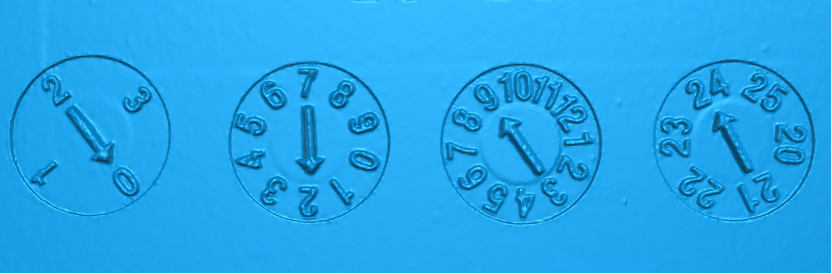
Scanned Data under OptimScan Q12 HD Small Range
As demonstrated in the scan data comparison, text and other fine surface features become more clearly distinguishable. This makes the Q12 HD particularly relevant for applications where capturing intricate geometric details is a priority.
Other Factors Affecting 3D Scanning Detail
Spatial sampling density and point distance are important considerations, but the final quality of 3D scan data is also influenced by the overall performance of the scanning system.
-
Optical Performance
The optical system affects image quality and the scanner's ability to distinguish fine surface features. Lens performance, image clarity, and the quality of the acquired optical information all contribute to the resulting 3D data.
-
Data Processing Algorithms
The reconstruction process converts captured image information into 3D measurement data. Data fitting, reconstruction, and optimization algorithms influence how effectively the acquired information is translated into the final point cloud.
These factors are particularly relevant to handheld laser scanners, which typically capture raw images at high frame rates. Their final 3D output is generated through multi-frame data processing, fitting, and optimization rather than being determined by an individual frame alone.
Consequently, the quality of the final 3D data depends on the combined performance of image acquisition, optical components, and software algorithms.
Conclusion: Key Parameters to Consider When Evaluating a 3D Scanner
A comprehensive evaluation of 3D scanning detail requires consideration of several interconnected specifications rather than camera resolution alone.
|
Parameters |
Technical Significance |
|---|---|
|
Camera Resolution |
Determines the number of pixels available for image acquisition. |
|
Field of View (FOV) |
Defines the area covered by the available pixels and influences spatial sampling density. |
|
Point Distance |
Indicates the spacing between neighboring points in the resulting point cloud. |
| Optical Performance | Influences image quality and the ability to distinguish fine features. |
| Data Processing Algorithms | Affect the reconstruction, fitting, and optimization of acquired 3D data. |
The appropriate combination of these parameters depends on the application, the dimensions of the scanned object, and the level of geometric detail required.
Frequently Asked Questions
-
Does a higher camera resolution always mean better 3D scanning detail?
No. Camera resolution determines the number of pixels available for image acquisition, but the field of view (FOV) determines how much area those pixels cover. A smaller FOV can provide denser spatial sampling with the same camera resolution. Optical performance and data processing algorithms also influence the final scanning detail.
-
What is the relationship between FOV and point distance in 3D scanning?
FOV determines the area captured by the scanner, while point distance describes the spacing between neighboring points in the resulting point cloud. Under comparable conditions, a smaller FOV generally produces denser spatial sampling and can result in a smaller point distance.
-
Does a smaller point distance mean higher 3D scanning accuracy?
Not necessarily. Point distance describes the spacing between neighboring points, whereas accuracy measures how closely the acquired 3D data matches the object's actual geometry. A smaller point distance indicates denser sampling, but it does not independently guarantee higher measurement accuracy.
-
What is the difference between point distance and resolution in 3D scanning?
Camera resolution refers to the number of pixels used for image acquisition, while point distance refers to the spacing between neighboring points in a 3D point cloud. They describe different stages of the scanning process. Camera resolution and FOV influence spatial sampling, while the final point cloud is also affected by optical performance and data processing.
-
What specifications should I consider when choosing a high-detail 3D scanner?
For applications requiring fine geometric detail, consider camera resolution, FOV, point distance, optical performance, and data processing capabilities together. The appropriate combination depends on the dimensions of the object, the complexity of its surface features, and the required measurement results.
Share on Social Media


