


%201.png?width=600&height=300&name=SHINING%203D%E2%80%99s%20Video%20Photogrammetry%20(VPG)%201.png)
101
Updated on Jul. 2nd 2026
What Is Photogrammetry? Exploring SHINING 3D’s Video Photogrammetry (VPG)
Discover how SHINING 3D’s patented integrated Video Photogrammetry (VPG) simplifies 3D scanning, enhancing accuracy without the need for coded targets, especially for large objects.
While traditional photogrammetry has long been used to improve measurement accuracy for large-scale metrology, recent advances have introduced Video Photogrammetry (VPG), which streamlines the workflow by replacing hundreds of static images with continuous video capture. This article explains how VPG works, how it differs from conventional photogrammetry, and why it is becoming an important technology in industrial 3D measurement.
What Is Photogrammetry
Introduction to Photogrammetry
Photogrammetry is a technology that uses a camera or combination of cameras to measure the shape, size, and spatial position of a subject. In short, this technique uses photography as a tool and measurement as a purpose to extract information from a 2D image and construct a 3D model.
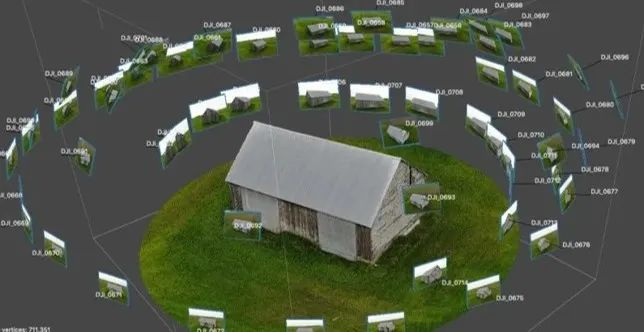
Photogrammetry
Why Photogrammetry Is Applied in the 3D Scanning Industry
3D scanning integrates optics, mechanics, electronics, and algorithms to measure and capture the spatial structure, dimensions, and color textures of objects, creating accurate digital 3D models. This technology converts physical objects into detailed point clouds and color data that computers can process. The process involves stitching together data from markers, features, or textures, which can introduce errors. These errors tend to accumulate, particularly when scanning large objects ranging from several meters to tens of meters in size.
To minimize the cumulative error, photogrammetry technology is introduced to high-accuracy 3D scanning. A high-accuracy handheld 3D scanner can be used to efficiently obtain dense point cloud information of the measured parts with markers; while photogrammetry equipment shoots scale bars arranged around the parts and the markers on the surface of the parts at multiple angles to form high-accuracy markers and coded targets framework in the software. The combination of the two data can control the global accuracy of 3D scanning of large-size objects.
.jpg?width=1059&height=400&name=coded%20targets%20on%20scale%20bars%20and%20marker(global%20markers).jpg)
coded targets on scale bars and marker (global markers)
Traditional Independent Industrial Photogrammetry System
In traditional industrial photogrammetry, coded targets and markers are placed on and around the object’s surface. High-resolution cameras capture the object from various angles and positions, producing a series of photos. These photos are then imported into software that automatically calculates the spatial positions of the coded targets and markers. The resulting data files can be imported into 3D data acquisition software, providing complete 3D data.
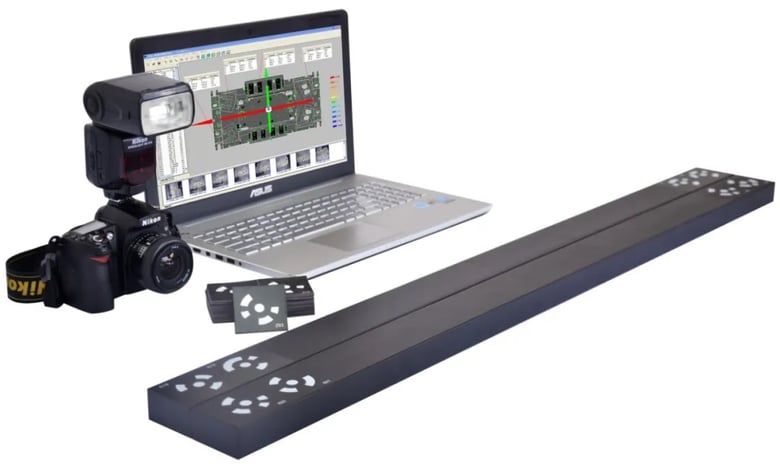
Traditional independent industrial photogrammetry system
Disadvantages
- Multiple angles and photo requirements: Requires users to stand at multiple angles around large parts and take numerous photos from fixed points.
- High learning curve: Requires operators to have extensive experience to ensure stable accuracy.
- Complex coded targets setup: Traditional photogrammetry systems require coding points to determine three-dimensional spatial relationships. The process of arranging coding points is complex, and larger objects require more coding points, which is time-consuming.
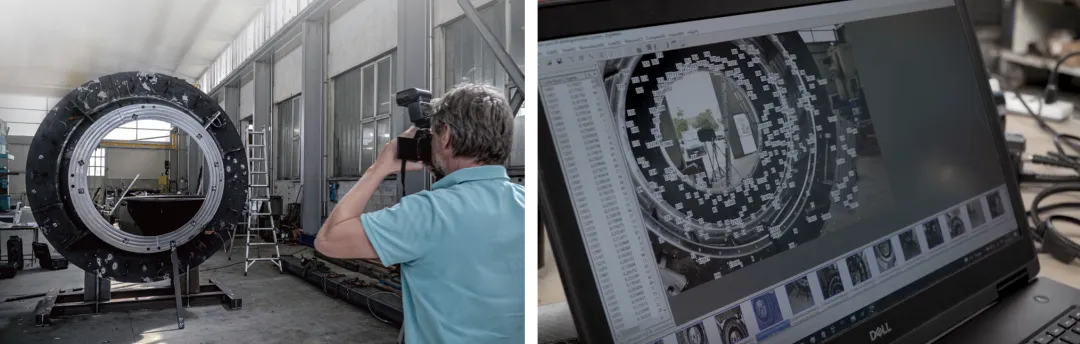 Traditional independent industrial photogrammetry
SHINING 3D’s Patented Video Photogrammetry (VPG)
Different from traditional photogrammetry methods, SHINING 3D’s patented video photogrammetry (VPG) technology eliminates the use of coded targets, reducing preparation time by at least half while maintaining the same high level of volumetric accuracy. FreeScan Trak ProW, FreeScan Trak Nova, FreeScan Omni, FreeScan Trio, FreeScan UE Pro2, all feature this advanced built-in video-based photogrammetry technology. By replacing high-resolution cameras with high-precision handheld 3D scanners and integrating a calibration rod, these models simplify the process. They eliminate the need to arrange coding points and utilize powerful algorithms to quickly establish the spatial position of large-scene target frames. This approach efficiently manages the global accuracy of 3D scanning for large objects.
 An engineer places a calibration rod on a turbine blade with VPG technology to improve the overall volumetric accuracy
Discover the product you're looking for
- Full specifications
- Using scenarios
- Key features
- Even comes with a bundle!
Share on Social Media


